
Rise In Unemployment Rate In December Is Warning Signal For India
Urban LFPR AND WPR Fell, No Improvement In Unemployment In Rural Areas

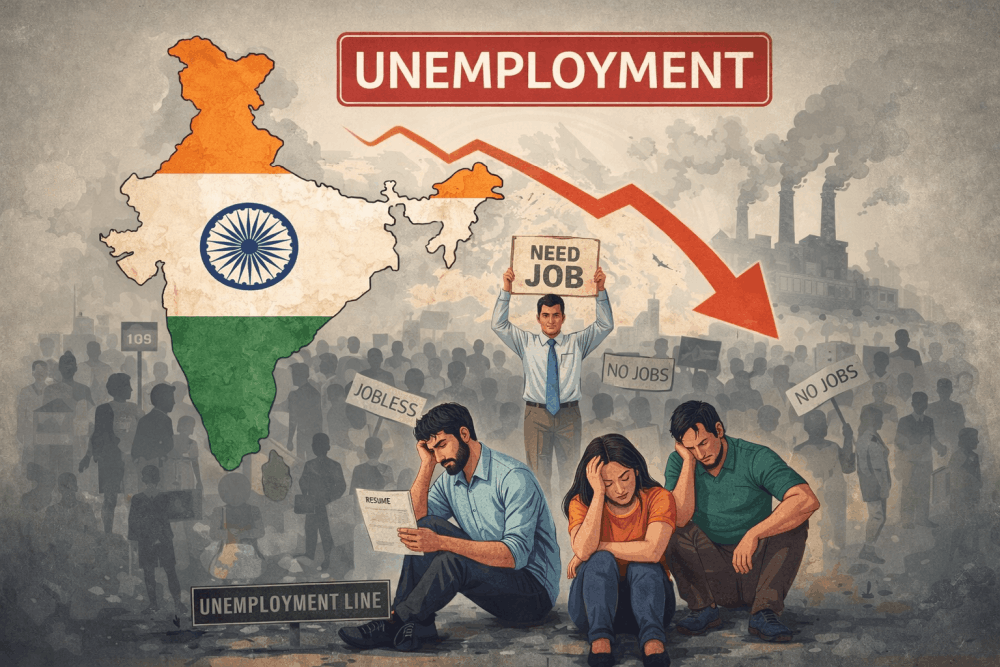
December 2025 registered a rise in the unemployment rate in India to 4.8 per cent from 4.7 per cent in November, despite the seasonal increase in agricultural and allied activity in rural India. Additionally, it should be a matter of concern that the unemployment rate in rural India failed to improve in November and December, which remained at 3.9 per cent, in spite of the general trend of rise in rural employment every year during sowing of Rabi or winter crops during October-December. Urban unemployment, on the other hand, rose to 6.7 per cent in December as against 6.5 per cent in November 2025. These should be a matter of serious concern for the Union government.
According to the Periodic Labour Force Survey (PLFS) of the Union Ministry of Labour and Employment for the month of December, the rural Labour Force Participation Rate (LFPR) and Worker Population Ratio (WPR) improved a little. However, it is surprising that such improvements failed to improve the rural unemployment rate which remained at the level of November at 3.9 per cent. It shows the complexity in the rural job market, which will become worse from now until March, when harvesting of Winter crops would provide an increased number of employment opportunities to the rural folk.
PLFS data shows a disturbing trend on the unemployment front. Unemployment rate in Current Weekly Status (CWS) was lowest at 4.7 per cent in November, which was 5.2 per cent in September and October, and 5.1 per cent in August. It has started rising.
Unemployment rate among youth in the age group 15- 29 worsened to 14.4 percent in December as against
14.1 percent a month before. The youth male unemployment rate rose to 13.7 per cent as against 13.4 per cent in November, while the female unemployment rate stood at 16.3 per cent in November-December.
In rural India, the availability of employment is tied to rainy and Winter crops. Employment rises in July- August, and then October-December. In August, the unemployment rate in CWS in rural India was 4.3 per cent which rose to 4.6 per cent in September, and came down to 3.9 per cent in November-December. The data, however, shows that female unemployment increased from 3.4 to 3.6 per cent while male unemployment remained at 4.1 per cent. Both male and female youth unemployment in the rural areas increased. Youth male unemployment rose from 12.4 per cent to 12.6 per cent, and female youth unemployment rose from 12.5 per cent to 12.7 per cent.
In urban India, unemployment among female stood at 9.1 per cent as against 5.9 per cent for male. Youth unemployment was very high at 18.1 per cent in December as against 17.8 per cent in November. Female youth unemployment stood as high as 24.9 per cent in December while it was 15.8 per cent for male youths, which rose from 15.3 per cent a month ago.
Worker Population Ratio (WPR) in CWS, that is the number of persons who worked for at least 1 hour on any day during the 7 preceding days of the survey, was 40.5 per cent in December 2025, only a 0.1 per cent improvement from November. Female WPR remained as low as 25.9 per cent as against 25.7 per cent a month ago. Male WPR increased from 55.1 per cent to 55.4 per cent during this period.
The distortion in the labour market in terms of male and female WPR is obvious. Similar distortion can be seen among youth WPR compared to WPR for the age group 15 years and above which were 53.1 per cent and 74.1 per cent respectively for males and 18.9 per cent and 33.6 per cent respectively. It gives a disturbing picture of youth employment in the country.
WPR for urban areas is even worse. It was 37.1 percent in December, 55.2 per cent for males and 18.5 per cent for females. Youth WPR in urban India was worse than this which stood at merely 33.5 per cent — 49.9 per cent for male youth and 15.9 per cent for female youth.
WPR for rural areas was little better at 42.1 per cent — 55.4 per cent for males and 29.2 per cent for females in December, though these are at a very low level. Youth WPR in rural areas in December was 37.1 per cent — 54.8 per cent for male youths and 20.2 per cent for female youths.
LFPR in CWS, that is the number of persons either employed or unemployed on average in a week of 7 days preceding the date of survey, was 42.5 per cent in December 2025, 58.1 per cent for male and 27.2 per cent for female. For youth, it was 42 per cent — 61.5 per cent for male youths, and 22.5 per cent for female youths.
LFPR in urban areas was only 39.8 per cent in December 2025 —58.7 per cent for males and 20.3 per cent for females. For youth, it was 40.9 per cent — for male youths 59.2 per cent and for female youths 21.1 per cent.
LFPR in rural areas, though still low, was better than in urban areas at 43.8 per cent — 57.8 per cent for males and 30.3 per cent for females. For rural youth, it was 42.5 per cent —62.7 per cent for males and 23.2 per cent for females.
If the low level of WPR is a clear indication of non- availability of work to our workforce, the low level of LFPR is also an indication of a lower level of participation of the workforce. Unemployment, worsening unemployment in urban areas, and no improvement in rural areas, is also signals for difficult days ahead.

Comments are closed, but trackbacks and pingbacks are open.