

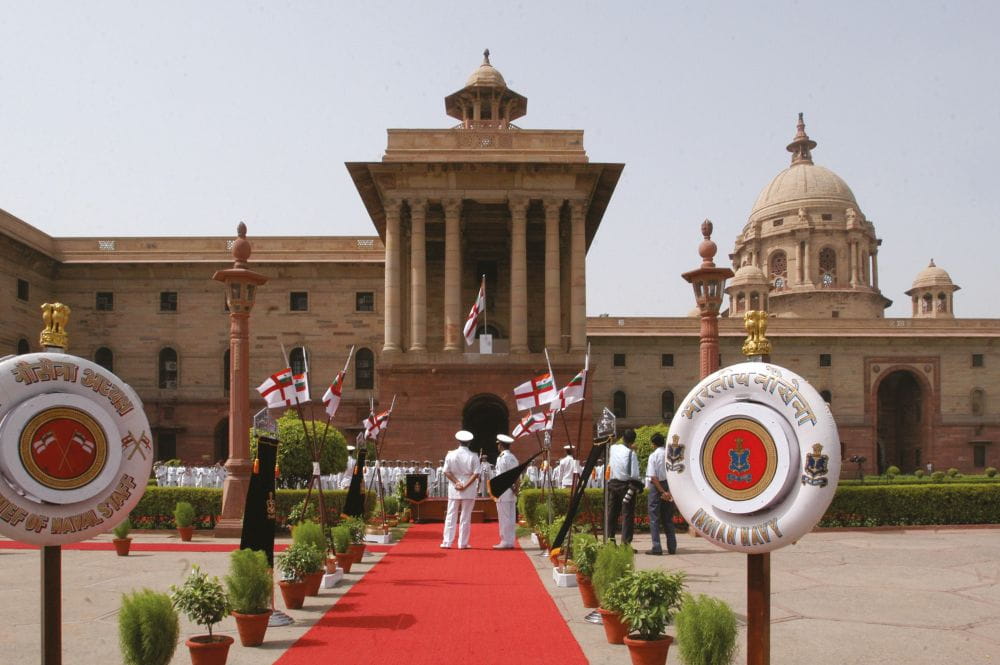
These two beautiful buildings in Lutyens’ Delhi have witnessed many historic decisions before and after
independence. Crucial decisions such as the British exodus from India, the struggle for independence, the 1971 Indo-Pakistani War, the creation of Bangladesh, the 1975 Emergency, the collapse of Indira Gandhi’s government, economic liberalization, the budget, foreign policy, and defense strategies were all taken in these buildings designed by Edwin Lutyens.
North and South Blocks are not just stone and brick buildings. They are silent witnesses to India’s triumphs and hardships. India’s Prime Minister’s Office (PMO) has been operating from this very South Block on Raisina Hill since independence in 1947. But now its location has changed. When India gained independence in 1947, the Prime Minister’s Secretariat began operating from South Block, part of the British-era Secretariat complex designed by Edwin Lutyens and Herbert Baker. Independent India’s first Prime Minister, Jawaharlal Nehru, worked from South Block. Every subsequent Prime Minister—from
Lal Bahadur Shastri to Indira Gandhi, Vajpayee, Manmohan Singh, and NarendraModi, including 16 other Prime Ministers—has worked from there. The building also housed the Ministry of External Affairs, the Ministry of Defence, and (to some extent) the Cabinet Secretariat. South Block became the symbolic nerve center of India’s executive power. Ever since their completion in 1931, the North and South Blocks on Raisina Hill have been central to India’s governance. They housed the government’s administrative centers, symbolizing power from the 19th century to post-independence. They have been a vibrant center of the
country’s governance.
These beautiful buildings in Lutyens’ Zone, once a highly sensitive and dynamic part of India’s governance, will now become a treasure trove of Indian history, holding many memories from the past. These magnificent structures will be transformed into the India Museum. Spread over 155,000 square meters, this museum will showcase the history of the country, of which these buildings have long been a part.
In August 1947, as independence seemed imminent, the lights in the South and North Blocks, designed by Edwin Lutyens and Herbert Baker, remained lit late into the night. Prime Minister Pandit Jawaharlal Nehru could be seen frequently visiting his South Block office to finalize the process of independence and partition, while Home Minister Sardar Vallabhbhai Patel, in North Block, attempted to integrate over 562 princely states into the Indian Union.
Just before departing, a resolution was tabled for the last time in South Block, stating, “…this complex has witnessed and shaped many historical events, from slavery to independent India.” The cabinets of 16 Prime Ministers have made important decisions from this structure. India’s successes were celebrated, failures were assessed, and strong and decisive decisions were made to address crises and challenges. After all the challenges, India is a confident nation today.
Over the past 20 years, the foundations of economic reform were laid in this very South Block. Decisions on DBT, Swachh Bharat, Digital India, demonetization, and GST were taken. It was from here that decisions like demolishing Article 370 and enacting a law against triple talaq were implemented. It was also from here that decisions like surgical strikes, air strikes, and Operation Sindoor were taken.
The Prime Minister’s Office (PMO) has been shifted to “SevaTeerth” and important ministries to Kartavya Bhawan.” For an evolving future, a modern, technologically advanced, and environmentally friendly office was needed, replacing the colonial-era North and South Blocks with a modern administrative hub. SevaTirtha has replaced he old South Block as the working space for the Prime Minister of India and the Central Executive Office, a first such move since independence. Seva Tirtha-1: It houses the Prime Minister’s Office (PMO), featuring open-plan modern workspaces and dedicated meeting halls. It also features a unique “India House” – a state-of-the-art conference facility for hosting international delegations
and high-level discussions, a feature previously unavailable at the former PMO site.
Indeed, many key government offices and ministries operated from fragmented and outdated infrastructure spread across multiple locations in the Central Vista area. This dispersion led to operational deficiencies and coordination challenges. The new building complex is modern, future-ready. SevaTirtha is part of the Central Vista redevelopment. Ceremonial spaces such as Kartavya Path (formerly Rajpath) have been redesigned.
Before 1947, the Viceroy and Governor-General’s Secretariat functioned from what is now Rashtrapati Bhavan and the Secretariat Buildings (North and South Blocks). During the British Raj, there was no “Prime Minister’s Office” in the modern sense. This building was part of the British-era Secretariat Building, inaugurated in 1931. In 1977, during Morarji Desai’s Janata Party government, the building was renamed the Prime Minister’s Office (PMO). Despite administrative expansion and structural changes, its physical location remained in South Block for nearly eight decades.
The Prime Minister’s Office has been moved to the new Executive Enclave-1, a few hundred meters away from South Block. The Ministry of Home Affairs and Personnel has moved to Kartavya Bhawan-3.”North and South Blocks are the centres of power and governance in the country.
Its story began in 1911, when the British Crown announced the transfer of India’s capital from Calcutta to Delhi. The task of designing the new imperial city fell to British architect Edwin Lutyens, whose grand vision gave birth to what later came to be known as Lutyens’ Delhi. However, the Secretariat buildings on Raisina Hill were designed by his contemporary, Herbert Baker. Completed in 1931, the symmetrical North and South Blocks were seen as towering symbols of imperial authority. Despite its grandeur, New Delhi’s inauguration on February 10, 1931, was seen by many as a royal imposition.
A.K. Jain, who has written several books on the making of New Delhi, says, “The British wanted to build a magnificent capital that would be a showpiece of the British Empire. Baker, who designed the Secretariat Building, was fascinated by Indian architecture and designed it in the Indo-Saracenic Revival style, which combined classical European elegance with Indian design elements such as red and cream-coloured Dholpur sandstone, large domes, pillared balconies, projecting chhajjas, intricate jaalis and jharokhas.”
Historian SwapnaLiddle writes in her book, “Connaught Place and the Making of New Delhi,” “The Secretariat buildings were as magnificent as Government House. They rose majestically above the Great Place, forming a ‘magnificent platform’ created by Baker. This effect was fully realized, as Indians soon began calling the Secretariat the ‘Fort of Raisina’ or ‘Raisina Fort.’ Here, Indian elements were more pronounced and less easily mixed with classical Western elements than in Lutyens’ architecture.”
The construction work was not without conflict. Lutyens and Baker famously debated whether to raise the Secretariat higher than Viceroy’s House, now Rashtrapati Bhavan. Lutyens wanted the Secretariat lower, fearing it would obstruct the view of the Viceroy’s House. However, Baker insisted on equal importance—and ultimately prevailed, Jain said. “The entire operation was imperialistic in nature and seemed designed to demonstrate the dominance of the white man.”
But, after independence, these corridors became the foundation of a new nation. India’s first Prime Minister, Jawaharlal Nehru, worked from South Block, while Sardar Vallabhbhai Patel worked from North Block, overseeing the unification of 562 princely states. Within these walls, the Five-Year Plan, decisions on war and peace, and the direction of economic reforms were decided.
Himanshu Roy, chairperson of the Centre for Political Studies (CPS) at Jawaharlal Nehru University and author of PMO: The Prime Minister’s Office Through the Years, said, “During Nehru’s time, what was known as the PM’s Secretariat had about eight people; during Lal Bahadur Shastri’s time, the PMO was institutionalized and became an advisory body, and during Indira Gandhi’s time, it gained an aura of power. It had hardly changed since independence, but during Rajiv Gandhi’s time, it was computerized, the basement was upgraded, and new chairs were installed.” “The grandeur of the building added an aura of
power to the PMO.”
SharatChander, a former information officer at the PMO, said, “What I always remember about South Block is the unique sense of history that permeates its corridors and courtyards: the paintings, the windows, and the rooms.” Chander added, “Also, I feel the country needs a new, modern office for the Prime Minister and his team. South Block was short on space. I still remember the tiny elevator everyone had to use. Therefore, moving to SevaTirtha, a modern building that reflects the new India, is timely and welcome.”

Comments are closed, but trackbacks and pingbacks are open.