
TRUMP’S TARIFF WAR CREATES DE FACTO COUNTERAXIS DRIVEN BY COMMON CAUSE
RUSSIA, CHINA, INDIA MAY WORK MORE CLOSELY FOR STRATEGIC TRADE AUTONOMY

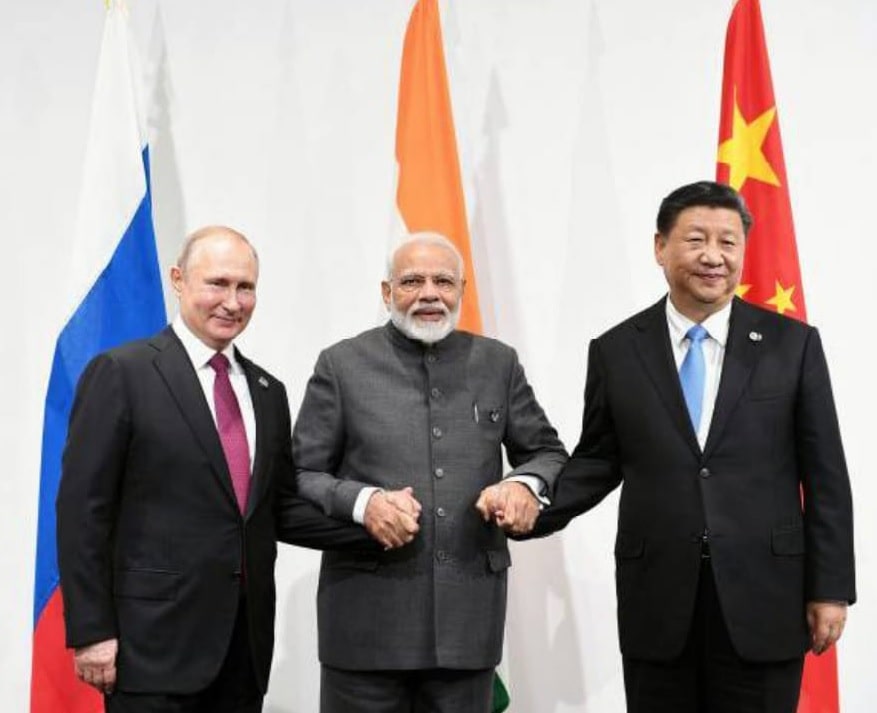
Donald Trump’s aggressive tariff regime, launched under the guise of bolstering American strength and reclaiming lost economic ground, has triggered a worldwide response that may ultimately defeat the very goal it seeks to achieve. Framed as a nationalist project to assert America’s economic primacy, the tariff war has turned out to be a catalyst for an accelerating global shift away from unipolar US dominance toward a truly multipolar world order. What was once largely speculative—the idea of a global economic architecture not centred on Washington—is now becoming tangible as Trump’s trade brinkmanship compels other nations to rethink, regroup, and realign.
The essential flaw in Trump’s strategy lies in its assumption that the rest of the world would blink first, caving in to American demands under the weight of economic pressure. But the world hasn’t blinked. Instead, countries are finding common cause in resisting what they perceive as economic coercion masquerading as negotiation. The result is a fluid yet increasingly coherent realignment of powers—chief
among them China, Russia, and India—that is beginning to operate as a de facto counter-axis to the
United States. Driven by shared grievances and the common objective of shielding their strategic autonomy, these nations are cooperating more closely in trade, investment, and energy.
The irony is that Trump’s pursuit of economic supremacy is hastening the erosion of the very system that enabled US dominance for decades.
Beijing, long a prime target of Trump’s tariffs, has responded with both retaliation and redirection. Rather than capitulating to Washington’s demands, China has expanded its outreach to other major economies,
particularly in Asia and Africa, while deepening its engagement with Russia and India. The Belt and Road Initiative, initially conceived as a means of global infrastructure connectivity, is now also a tool for economic realignment. As Trump builds tariff walls, China builds roads, ports, and financial networks that
bypass the United States. Moscow, for its part, has welcomed this pivot. Isolated by US and European sanctions, Russia sees opportunity in closer ties with China and India, both of which have shown increasing
willingness to defy Western pressure.
India, though traditionally more aligned with the West and an enthusiastic participant in global liberal markets, has found itself inching toward the emerging non- Western axis. Trump’s tariffs on Indian goods, coupled with his administration’s threats of secondary sanctions on countries trading with Russia or buying
Iranian oil, have forced New Delhi to draw red lines. India’s stance on Russian oil, for instance, has been unambiguous: it is a matter of national interest and energy security. Any effort by Washington to curtail these purchases is seen not just as economic interference but as a direct challenge to sovereign decision-making. In retaliation, India has dangled the cancellation of key defence deals, including the proposed purchase of the F-35 fighter jets—a symbolic snub that indicates a broader reassessment of strategic
alignment.
What makes this realignment especially potent is the breadth of its scope. It is not merely a matter of retaliatory tariffs or diplomatic rhetoric; it includes infrastructure cooperation, technological integration, and long-term investment planning. China and India, despite historic differences, have increased dialogue in recent months on trade facilitation and regional connectivity.
Russia’s role as a common energy partner and military supplier to both nations gives it leverage in the triangle. And with US credibility as a dependable trade partner being questioned, many smaller nations are also hedging their bets, diversifying their economic relations away from a US-centric model. Even traditional US allies in Europe are uneasy. Germany and France have voiced concerns about the destabilizing effects of Trump’s tariffs on global trade norms. The EU is pursuing its own trade treaties with
countries like Japan and Vietnam, carving out autonomous space in global commerce that doesn’t
necessarily involve Washington.
At the heart of this geopolitical churn is a growing skepticism toward the idea that the United States can or should dictate the terms of global trade. The Trump administration’s belief that economic might translates
automatically into negotiating power has ignored the subtle but critical fact that globalisation has made nations more interconnected and interdependent. Trying to weaponise trade may yield short term
leverage, but it also creates lasting rifts and compels partners to seek alternatives. The economic structures of the 21st century no longer afford any single nation the luxury of acting as an economic
autocrat without consequences.
Furthermore, the economic impact within the United States is more complex and less flattering than the populist rhetoric suggests. While certain domestic industries may benefit from tariff protections, others are suffering from rising input costs and retaliatory measures. American farmers have been hit particularly hard by Chinese tariffs on agricultural imports, prompting the Trump administration to introduce multibillion-dollar bailout packages that, in effect, cancel out the supposed gains of the trade war. Manufacturing, far from being resurgent, is experiencing uncertainty and disruption due to volatility in global supply chains. The idea that tariff wars are “easy to win” has proven to be one of the most misguided statements of Trump’s presidency.
Even American multinationals, once eager advocates of “America First” policies, are quietly relocating parts of their supply chains to countries not caught in the tariff crossfire. This shift not only diminishes the US’s leverage but also accelerates the decentralization of economic power. No longer is the American market an irresistible magnet for global commerce; it is increasingly seen as a zone of instability and risk. For many countries, the trade war has been a wake-up call—an impetus to invest in regional blocs, alternative trade corridors, and new financial instruments insulated from US influence.
In the broader scheme, what Trump has unwittingly triggered is a reimagination of how global power is structured. The post- Cold War illusion of US-led globalisation is being replaced by a more pluralistic, competitive, and fragmented order. Emerging powers are no longer content to play by rules written in
Washington. They are building parallel systems: China’s digital yuan aims to reduce dependency on the dollar; India and Russia have revived rupee-rouble trade mechanisms; and regional trade agreements like RCEP are functioning without US participation. What’s being born is a new kind of globalization—less
hierarchical, more balanced, and far less dependent on any single country.

Comments are closed, but trackbacks and pingbacks are open.