
WOMEN WORKERS FACING DOUBLE THE RISKS FROM GENERATIVE AI THAN MEN
NEW ILO DATA RELEASED ON THE EVE OF INTERNATIONAL WOMEN’S DAY WARNS

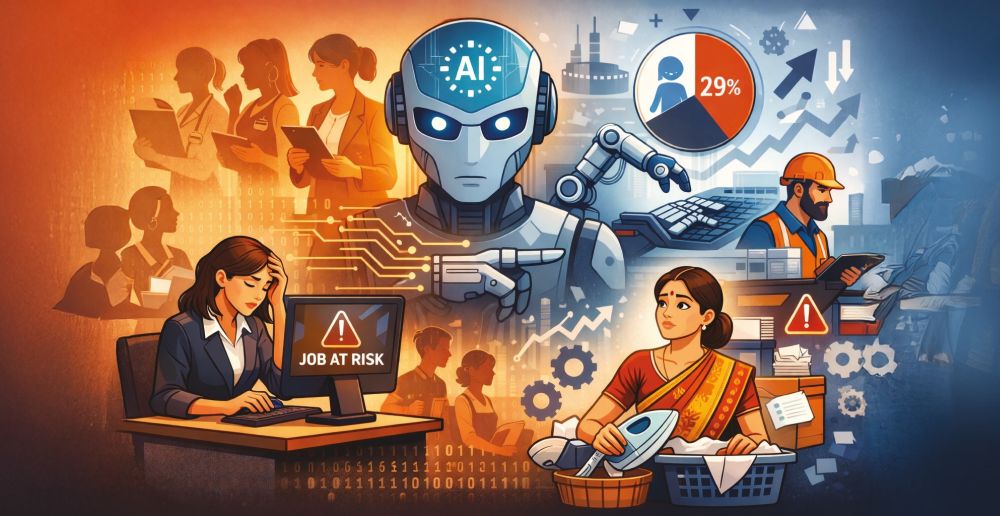
As the world is celebrating the International Women’s Day on March 8, a new concern has emerged for women workforce. They are facing double the risks from Generative AI (Gen AI) compared to men, which an International Labour Organisation (ILO) research brief has just confirmed. Drawing on an innovative global index of occupational exposure to Gen AI and new evidence from ILO’s harmonized microdata covering 84 countries, the brief marking the International Women’s Day says that the impacts of deployment of Gen AI are not gender- neutral.
Considering all four exposure gradients, women are more exposed overall to Gen AI than men inmost (88 per cent) of countries in the sample. Overall, Europe and Central Asia and Latin America and the Caribbean are the two regions with the highest levels of exposure for female workers on average, while Africa and Asia have the lowest exposure.
Currently 82 occupations out of 436, that is 19 per cent, are female dominated, which are almost twice as likely to be exposed to Gen AI as male-dominated ones – 29 per cent for women compared to 16 per cent for men, reflecting women’s concentration in clerical, administrative and business support roles with routine tasks which are at greater risk of automation. At the same time, women remain underrepresented in AI-related jobs, limiting their access to emerging opportunities and influencing how technologies are designed and deployed. Grouped in six clusters, female-dominated occupations are prominent in the sectors: health and care, teaching, social work and culture, business administration and clerical support, personal services, sales and food preparation, and finally, textiles and wearing apparel manufacturing.
A total of 89 occupations, that is 20 per cent are male-dominated. Men workers are concentrated in construction, building, manufacturing and trade as well as in occupations relating to science and engineering, information and communication technologies, protective services, drivers, and agriculture workers. Male-dominated occupations also include some chief executives, senior officials and armed forces.
Remaining 266 occupations, that is 61 per cent are mixed. These include occupations across all exposure gradients ranging from hotel managers (gradient 1) to call centre workers(gradient 4), as well as occupations that are not exposed to Gen AI technology.
For most occupations, the impact of Gen AI is more likely to be felt through changes in tasks, skills and working conditions rather than widespread job losses. The brief highlights that the policy choices made today – including strengthening social dialogue, addressing occupational segregation and ensuring women’s representation in AI-related role– will be critical to ensuring that technological change supports decent work and advances gender equality.
Though the Gen AI is evolving at an unprecedented pace, creating both opportunities and challenges for employment, productivity and working conditions, its impacts are not gender-neutral, often shaped by persistent inequalities between women and men in access to decent work, leadership and economic opportunities, the brief has highlighted.
In countries with available data, female-dominated occupations, such as business administration and clerical support, women workers are almost twice as likely to be exposed to Gen AI as male-dominated ones such as construction, manufacturing and trade (29 versus 16 per cent). They also face much higher automation risk (16 per cent for female vs. 3 per cent of male-dominated occupations).
Exposure to Gen AI varies widely across regions and income levels. In high-income countries, 41 per cent of jobs are exposed, compared to 11 per cent in low-income countries. These gaps reflect differences in occupational structures and sectoral composition, digital readiness and skills.
Women are more exposed to Gen AI than men in 88 percent of countries in the sample. The highest levels of exposure (over 40 per cent of female workers) is found in small island countries in the Pacific and the Caribbean, as well as in European countries such as Switzerland and the United Kingdom, and in the Philippines. This can be likely attributed to a higher share of women in the services sector and the rapid expansion of AI in these economies.
The higher exposure of women is closely linked to entrenched occupational segregation and the systemic barriers that sustain it. Discriminatory social and legal norms and biases in recruitment, promotion and workplace practices, and macroeconomic and sectoral policies often shape labour markets in ways that have implications for women’s equality of opportunities and treatment.
Gen AI is expected to drive job growth in tech-intensive sectors, yet women remain underrepresented in Science, Technology, Engineering, and Mathematics (STEM) and AI, making up only 30 per cent of the AI workforce globally.
Gaps in access, skills and use are compounded for women facing intersecting inequalities while underrepresentation in AI development, risks perpetuating gender-bias in technologies and deepening the digital divide.
The more widespread impact of Gen AI lies in the quality of employment rather than quantity through its reshaping of tasks, work organisation and skills. It can intensify workloads, reduce autonomy and introduce bias. Yet Gen AI also has the potential to improve job quality by easing physical demands, supporting well-being and enhancing workplace safety and equality, including at enterprise level. This requires Gen AI be designed inclusively and supported by strong labour market institutions and social dialogue.
The policy choices made now will determine whether GenAI drives greater equality or entrenches disparities in the world of work, and whether opportunities are seized or lost.
Embedding gender equality in the design, deployment and governance of GenAI, tackling the drivers of occupational segregation, and ensuring women’s representation in AI-related roles are essential. Social dialogue is fundamental to ensuring that technological transformations enhance working conditions and advance an inclusive world of work.

Comments are closed, but trackbacks and pingbacks are open.